Society golf / Enquiry journey
What should a golf society organiser find before making an enquiry?
A practical society-golf journey from organiser requirements and package comparison to a useful enquiry, named owner and club-agreed response expectation.
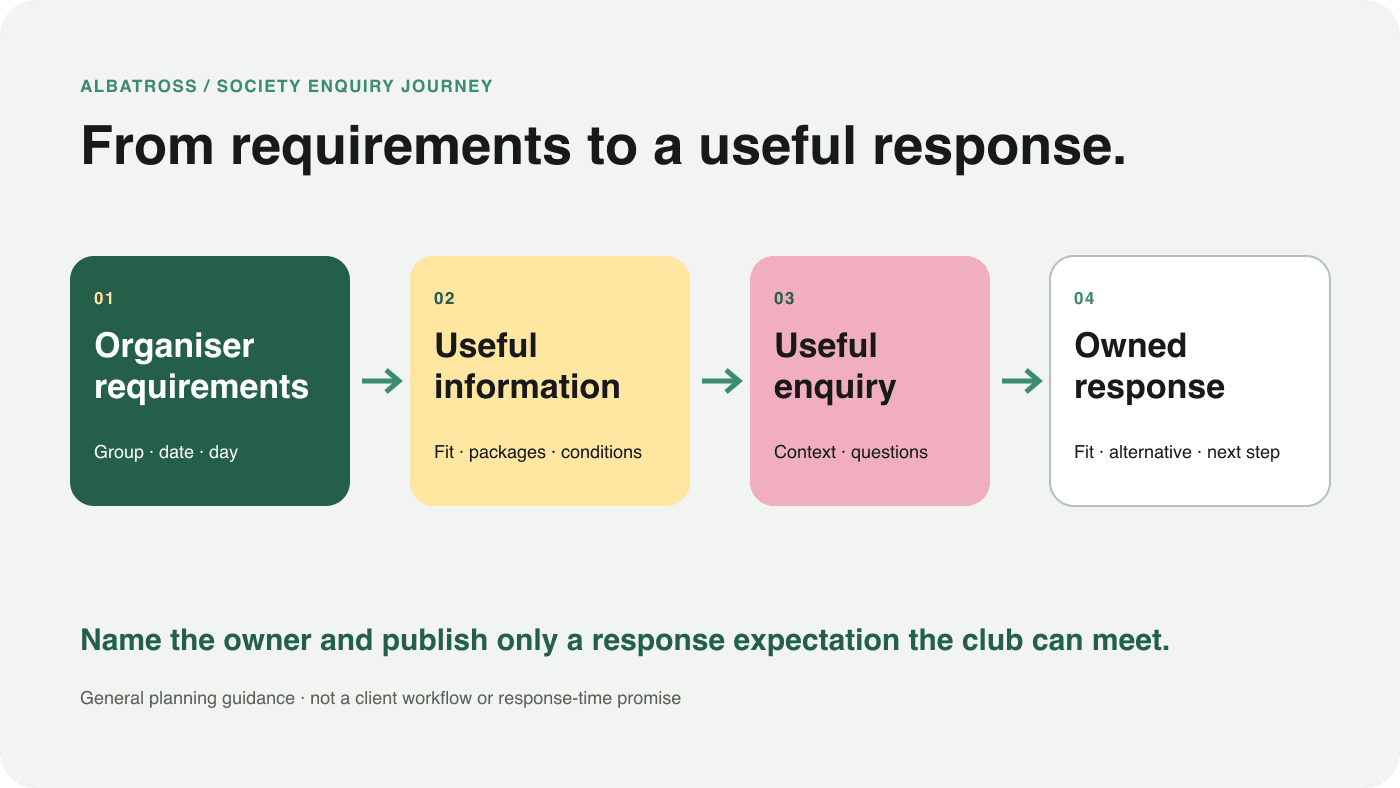
Help the organiser compare before asking them to enquire.
A society organiser usually needs to assemble a workable day for a group, not simply find a golf club. Before making an enquiry, they should be able to see whether the club can suit the likely group size, timing, golf format, hospitality needs and practical requirements.
The page does not need to settle every detail or publish a fixed package for every situation. It should help the organiser rule the club in, understand the choices and send enough context for the club to respond usefully. The journey then needs a named owner and a response expectation the club has actually agreed.
Start with the organiser's real requirements.
Design the page around the decision an organiser is making. They may have a firm date and flexible catering, or a fixed group size and several possible dates. They may need a simple golf day, a meal and presentation, or support for mixed experience levels.
Show which requirements the club can answer on the page, which are choices within a package and which need staff confirmation. A long gallery with one “contact us” button leaves the comparison work to an already busy organiser.
Useful-information checklist
Give package choices enough structure to compare.
- The group sizes, days, seasons or booking windows the club is prepared to consider.
- The golf format available, relevant course information and material playing requirements.
- The package choices and what each includes, described in a form organisers can compare.
- Food, arrival, changing, buggy, practice or hospitality options that materially shape the day.
- Accessibility, dress, handicap, deposit, cancellation or other conditions the club requires organisers to know.
- Which details remain subject to availability or a tailored quotation.
- A clear enquiry route and what information will help the club provide a useful response.
If a price or inclusion varies by date, group or package, say that plainly and explain what the club needs before it can confirm a quotation. Avoid “from” language that hides mandatory elements. Keep availability and conditions owned by the team responsible for fulfilling the day.
Copyable enquiry brief
Ask for the fields needed to make the first response useful.
Use the smallest set that lets the receiving team assess fit and continue the conversation. Explain optional fields and avoid collecting details the club does not need at this stage.
Organiser
Name, preferred contact details and permissioned route for the club's reply.
Group
Likely number of golfers and any material experience or accessibility requirement.
Timing
Preferred date or range, acceptable alternatives and preferred tee-time window.
Package
Golf format, food or hospitality interest, and the option being compared.
Questions
The specific details the organiser still needs in order to decide.
Source
The page, partner, campaign or other route that led to the enquiry, where the club can record it accurately.
Design the response before releasing the form.
The club should decide which role receives the enquiry, who covers absence, where the record is kept and what counts as a response. An acknowledgement can confirm receipt; it is not the same as a useful answer from someone who can check dates, packages and next steps.
Set a response expectation the club can meet, write it in language the organiser can understand and give exceptions an owner. Record what happens when a date is unavailable, a group falls outside the usual package or more information is needed. This is a human service handover even when systems help route or record it.
Clearly fictional worked journey
A useful handover for Hawthorn Mere.
Hawthorn Mere Golf Club, its process and every detail below are fictional. The example demonstrates the method; it is not evidence of a club setup or result.
On a smaller screen, scroll across the table to review the handover.
| Journey point | Agreed detail | Owner |
|---|---|---|
| Information | The society page shows the group range considered, weekday windows, package components, practical conditions and details requiring confirmation. | Golf operations owns availability and playing conditions; hospitality owns food and room information; marketing owns the published page. |
| Enquiry | The organiser supplies contact, group size, preferred and alternative dates, likely package and open questions. | The society coordinator receives the form and checks completeness. |
| Response expectation | In this fictional example, the club promises a personal reply by the end of the next working day. An enquiry received on Friday receives a reply on Monday unless it is a bank holiday. | The society coordinator responds; the golf manager covers when the coordinator is away and owns unusual availability decisions. |
| Next step | The response confirms fit, asks for a missing detail, proposes an alternative or explains that the club cannot accommodate the request. A quotation follows only after the required facts are checked. | The society coordinator records the status, next action and responsible person. |
This journey complements the club's wider campaign plan. Use the society and event marketing overview to connect the offer, audience, destination and next step.
Campaigns by Albatross
Make the society journey useful from first comparison to club response.
Albatross can help shape the offer, page, campaign and handover around the society opportunity your club can fulfil.